In L.A., dumped trash is suffocating neighborhoods, businesses, community spirit.
Volunteer `trash vigilantes' have stepped up, with their own time and money, to do what they can. Yet L.A.’s trash tests the limits of volunteers doing so much of a job that belongs to government.

This week’s story is part of my occasional series on the effects of fentanyl and methamphetamine on U.S. streets. It was produced in collaboration with, and the support of, LAReported.org, an online startup sponsoring deeply reported journalism about Los Angeles — which publishes the piece today as well. Please share it!!!
* * * *
Every Wednesday, Sabine Phillips pedals her yellow beach cruiser around a 12-square-block strip of Hollywood’s east side, filling her notebook with the locations of discarded couches, mattresses, old TVs, cabinets, aquariums, wall paneling, and just plain trash — reporting it to the city’s 311 service line.
For this, plus picking up three or four bags of trash every weekend, she earns $800 a month.
“When I talk to people in the neighborhood, I hear it a lot: `Somebody ought to do something about it,’” Phillips told me when I met her on Virginia Avenue near Western Avenue in Hollywood.
On the sidewalk, as she took notes, a blue recycling bin overflowed with trash, surrounded by dumped boxes, a junked flat-screen TV, a couple discarded coffee tables, stacks of drawers from a dresser, and scattered litter. “This corner is trashed up all the time,” she said.
Phillips was hired by Stephanie, a Hollywood photographer who for years had waged a one-woman war on the increasing piles of trash before she found her civic efforts were interfering with her business. She pays Phillips out of her own pocket.
Stephanie, who asked that I use only her first name to protect her business, started by picking up litter constantly.
But the trash was even more constant. Apartments without on-site managers bred trash dumping. Street vendors left bags of trash every evening. And renters moving out would dump mattresses, sofas, old TVs.
“Once homelessness really got bad, these bulky items were within an hour of becoming an encampment,” Stephanie said. She drove her streets looking for illegal dumps, bulky items left on corners – reporting their locations to the city’s 311 line.
The homeless themselves had changed. Those she saw now seemed belligerent, incoherent. Stephanie said one spray-painted her face and another threw bricks at her as she tried to clean the streets. “The type of drugs changed the kind of homelessness there was,” she said. “Then the pandemic and complete non-enforcement spread [the trash] all over.”


Behind this relentless flow of trash is the spread of tent encampments during COVID-19, a general lack of consequences for dumping trash, residents uninformed about city trash services and a change in homelessness caused by methamphetamine addiction.
Meanwhile, the city’s sanitation department had gone without an increase in monthly fees for residential trash pickup since 2008 – the deficit made up by the city’s general fund.
I wrote to a media spokeswoman for the city’s Bureau of Sanitation (LASAN), who emailed back that last year the department “addressed more than 13,000 chronic dumping locations across Los Angeles, collecting more than 13,500 tons of trash.” Reports of illegal dumps rose from 73,000 in 2024 to 91,000 last year, though many were duplicate reports, so it is impossible to say how many illegal dump sites the city actually had.
Despite several weeks of asking, the spokeswoman did not respond to my requests to interview LASAN officials about the situation – and how going 18 years without a fee increase affected the bureau. She did provide a consultant’s study on the city trash problems, and the lack of a fee increase.
The galling accumulations of garbage are poised to be a major issue in this year’s council and mayoral elections.
Meanwhile, into this littered void have stepped residents like Stephanie.
Call them trash vigilantes, made desperate by the crisis and their own outrage at what they see around them — who use their own time and money in an attempt to clean their neighborhoods and keep back this flood of garbage.
Stephanie organized an inter-neighborhood clean-up on NextDoor as the pandemic retreated. Two people showed: Stephanie and Keith Johnson, also a photographer, who had taken on a similar task for his neighborhood eight blocks away.
For a while, they paid a neighborhood trucker to occasionally drive their streets, hauling away anything that could be used to start a homeless encampment — sofas, mattresses, large chairs.
But the relentless trash and the city’s incapacity or ineptitude met residents’ apathy and they fed on each other. “It was taking care of an entire neighborhood,” Stephanie said. “I couldn’t do it myself anymore.”
That was when she hired Sabine Phillips.
Trash vigilantes also have emerged in Venice, South L.A., Larchmont, and Silver Lake.
“It’s to bring back a bit of pride in the city — stop walking by the trash on your street,” said Chris Shanley, an architect who organizes cleanups through a neighborhood committee in Larchmont he helped form last year.
Juan Naula, an Ecuadoran immigrant who has lived in the United States for 30 years, last year started a nonprofit, Clean LA With Me. Through it, he accepts donations and now spends virtually all week clearing trash from L.A.’s beleaguered neighborhoods and businesses. On Saturdays, he runs trash MeetUps, marshaling volunteers to clean different neighborhoods. “My goal is to do 52 this year,” he said.
All this has been building for years. In 2021, then-City Controller Ron Galperin issued a report – “Piling Up” — on city trash. Requests to pick up dumped trash had nearly tripled: from 850 a month in 2017 to 2,494 a month in the first eight months of 2020, Galperin reported.
During the 2010s, homelessness also spread, along with semi-permanent tents and relentless supplies of methamphetamine. The hyper-potent version of the drug, coming out of Mexico, now covers Los Angeles. It promotes homelessness and psychosis, along with hoarding and digging wildly through trash bins.
Skid Row east of downtown saw this collision first. It was the city’s first tent-colonized neighborhood by 2013 and 2014, just as meth replaced crack as Skid Row’s most common drug for sale.
Massive amounts of trash followed. It came from tent-ensconced homeless people — and from charities that donated food and clothing, much of which remained to fester as garbage.
Skid Row’s Business Improvement District was forced to become the city’s first private entity to take on the task of daily, public trash collection. It now employs 23 people to collect trash: almost 1,200 tons in 2016, rising to more than 3,400 tons by 2024, which is separate from what the city also collects in Skid Row.
By 2018, Skid Row had outbreaks of typhus, borne by rats feeding on the garbage and carrying fleas that spread the disease.
Skid-Row-style tented homeless encampments were spreading to Venice, Hollywood, and other areas. Much of this was encouraged by court cases, which held — or were interpreted by city officials to hold — that homeless people had rights to live on the sidewalk and keep bulk items: couches, tables, televisions.
Many nearby cities hold the opposite interpretation of these court cases, and prevent tent encampments from forming.
But in Los Angeles, when residents complained, city officials “just blamed the court,” Elizabeth Mitchell, attorney for the L.A. Alliance for Human Rights, which has battled the city over its encampment policies, wrote in an email. “It’s still happening, but to a lesser extent. The mayor has made some visible encampment-reduction efforts, but largely in the most visible or wealthy areas, while places like Skid Row are exploding with trash.”
Yet homelessness is only part of the city’s trash problem. The issue is married, as well, to a lack of consequences for dumping trash. Ron Galperin, in his 2021 report, found the city had no comprehensive strategy to attack illegal dumping and “little work put into educating the public” about trash collection.
In November, the Los Angeles City Council finally approved increasing monthly residential trash-pickup fees by 80 percent from 2026 to 2029. Still, LASAN is playing a massive game of catch-up.
In Hollywood, with a large immigrant population, the lack of education about the trash-collection system means that recycling bins sometimes stay on the street all week, filling with trash. The city won’t pick up trash in a recycling or compost bin.
All this has fostered a general disregard for individual responsibility among L.A. residents.
“Trash signals that we don’t care about the city,” said Dylan Kendall, who is running for Council District 13 seat, which includes Hollywood. “It’s the first domino that falls when we start to see an erosion of our city life.”
In many areas, trash stifles small businesses, which in turn reduces the collection of taxes that fund city services just as Los Angeles addresses huge budget deficits.
One business is Kalaveras, a Mexican restaurant on Silver Lake Boulevard, at the Hollywood Freeway overpass. Homeless people routinely go through the restaurant’s trash bins, a manager told me: “We throw out stuff, then three days later we’ll see it strewn on the street. Flowers, plates, decorations. We had this whole area cleaned a month ago.”
Recently, the restaurant recruited Juan Naula to organize a clean-up. Trash lay along the street, piled next to the freeway offramp, and embedded in an encampment on a street island.
L.A.’s trash problem “is worse than a Third World country. Not even Ecuador looks like this,” Naula said. “Everyone has to do their part. The government, businesses, the people. Everybody.”
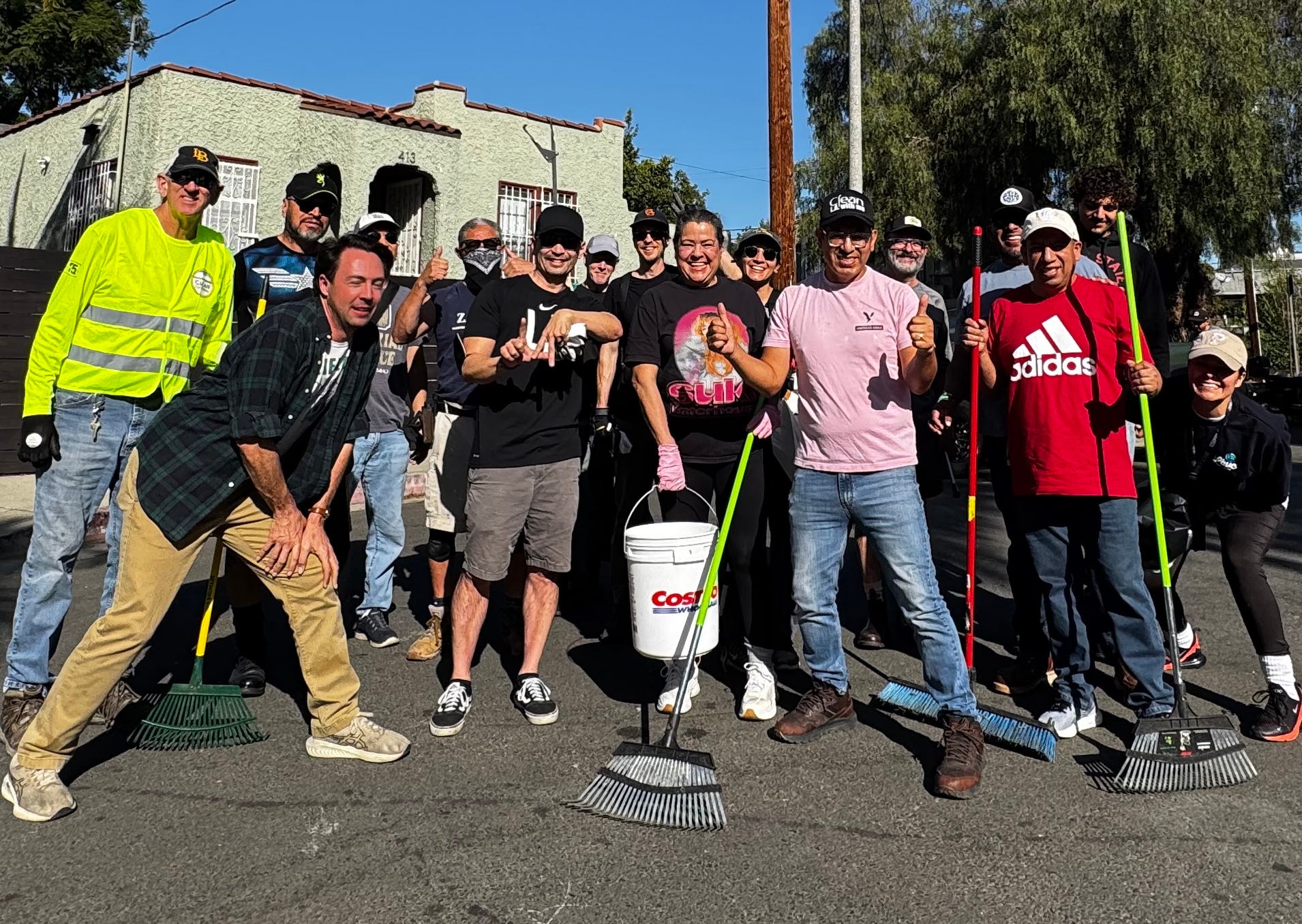
He assembled a group of 15 volunteers, outfitted with rakes, gloves, brooms and trash bags. It took them an hour to remove it all – though they left the encampment intact, so they may have to return in another month. Then they broke for lunch provided by Kalaveras.
“People need community now more than ever,” said Rich Sarian, a member of the group, who is vice president of the South Park Business Improvement District downtown. Sarian is seeking signatures to run for the seat in Council District 13, which includes Hollywood and Silver Lake. “I hate that there’s so much trash on the streets but it gives us a reason to come together.
Yet L.A.’s trash also tests the limits of a volunteer force doing so much of a job that properly belongs to government.
Indeed, volunteers face a difficult choice: If they clean a litter-strewn street, dumpers are absolved of consequences; but leaving trash allows it to fester, along with residents’ sense that there’s nothing to be done.
Recently, Stephanie told me, she was cleaning the trash from a spilled garbage bag left in front of a nearby apartment building for two days. She asked a tenant to help.
“I didn’t put it there,” he said.
Thank you for reading! I do not paywall this newsletter. … But if you’d like to keep it going, please consider becoming a paid subscriber.
It supports my journalism and ensures that every article remains open to everyone
Thank you for your support!
MORE STORIES FROM MY DREAMLAND NEWSLETTER:
The Saga of an L.A. Shelter — how a homeless shelter, supported by neighbors, disintegrated into crime and blight.
“Natalie” — An audio tale in which California prison inmate tells the story of a friendship he struck up with an old lady — a Holocaust survivor and shut-in — when he was 7 years old.
My Visit to Muskogee, OK: The small town Merle Haggard once sang about reflected what was going on in an ignored part the country. Almost 60 years later, it may still.
PHOTO OF THE WEEK: Snow on branches (Nashville, TN)