

The Beautiful Literary Love Story of Elizabeth Barrett Browning
How an ill, shut-in Victorian poet found freedom and love through poetry.

For many years, the English poet Elizabeth Barrett (1806-1861) lived in an upstairs bedroom of her father’s house,with her spaniel, Flush, and didn’t leave other than when carried downstairs by a brother.
I learned her story from this book of poems, which I found in a bin at the Goodwill Outlet I go to.

No one’s quite clear what all afflicted her. She injured herself saddling a pony at 15. Life was never the same. She suffered from chronic spinal and cranial pain perhaps. Perhaps a pulmonary disease. Perhaps also what was then called female “hysteria” and neurosis.
She described herself as “sublimely helpless and indolent.”
Yet from that room, in that state, she wrote poetry that England fell in love with. She remained in her room for years while, far beyond her room, her poetry grew famous.
Her father, Edward, owned a sugar plantation in Jamaica and the slaves that worked it. He also controlled the lives of his twelve children, of whom Elizabeth was the oldest. He forbade any of them from marrying, or leaving home.
Yet he proudly exhibited his famous daughter to visitors, and therein lay her eventual escape. In 1845, one of these visitors was the poet Robert Browning, who had written to her.
His first line got right to the point. “I love your verses with all my heart, dear Miss Barrett,” he wrote.


With her father’s approval, Browning took to visiting her. Soon after his first visit, Browning wrote to announce his love for her, which, from her response, must have been a torrid letter, but is the only letter of theirs that does not survive.
They secretly wrote 573 letters to each other over the next year. Their love grew through these letters and his visits. “I am yours in everything except to do you harm,” she wrote him.
Meanwhile, Robert urged her to leave her bed and helped her walk around her room — all unbeknownst to her father.
Turns out, walking and love restored Elizabeth to life, perhaps strengthening her immune system and muting infections.
Critics note that until she met Browning, her poetry and writing was diminishing. During their romance, she began writing these sonnets. Her verses are of love, but this was Victorian England and she was of the Romantic Movement in English poetry, so it was of a swooning soul’s love she wrote, and barely, I’ll say not at all, of lustful, sweaty flesh.
In the first of Sonnets from the Portuguese, she laments her “melancholy years” as a shut-in, yet ends like this:
“And a voice said in mastery as I strove, ..
`Guess now who holds thee?’ -- `Death,’ I said, But,
there,
The silver answer rang .. `Not Death, but Love.’
Among her poems is her most famous, now a Valentine’s Day greeting-card staple, which begins:
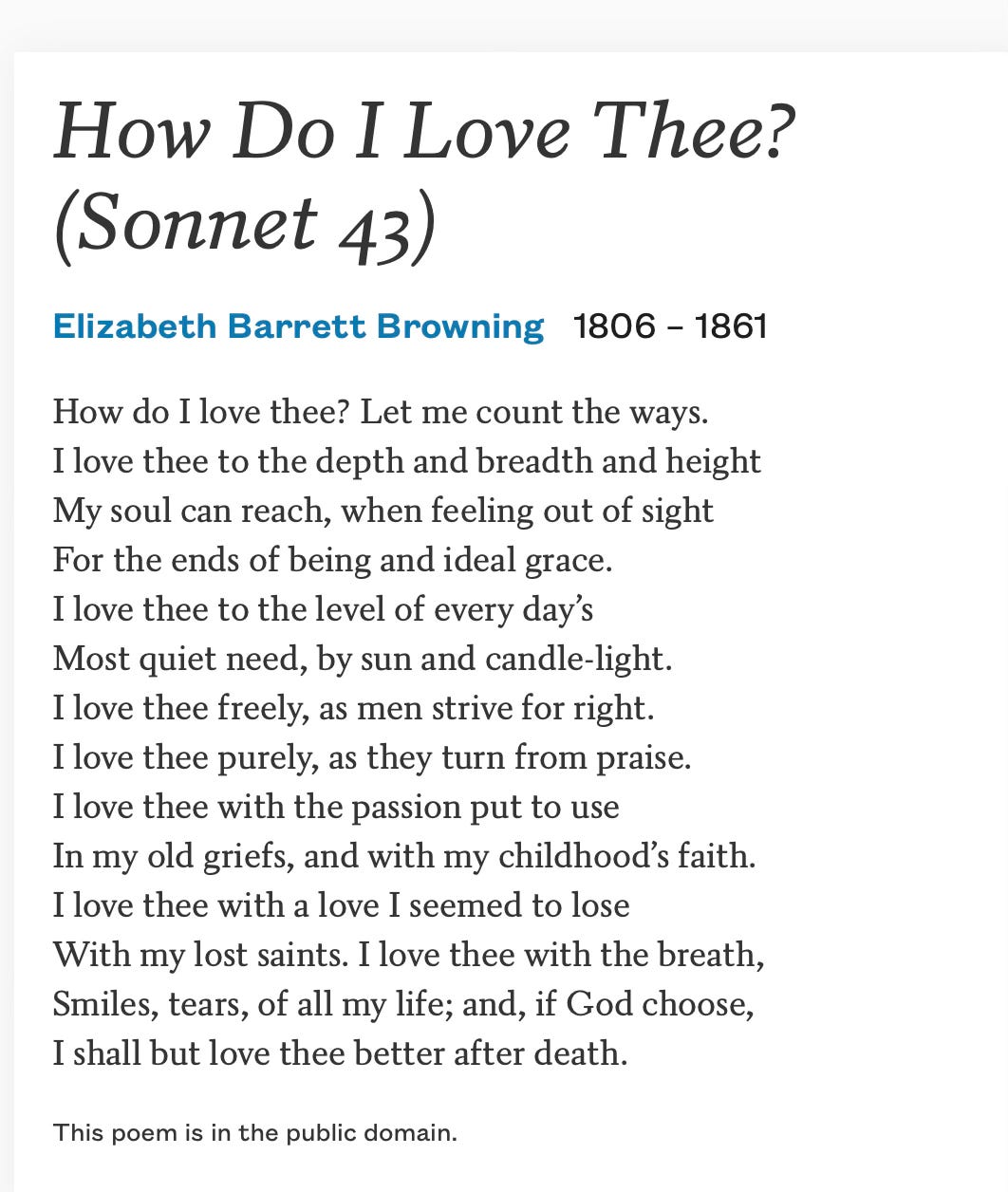
“How do I love thee? Let me count the ways.” (Hear Dame Judy Dench read the poem, below.)
After about a year of hidden romance, Robert proposed marriage.
To elude her father, they eloped in 1846, leaving the house when everyone was gone, heading to a church with Elizabeth’s faithful maid, Elizabeth Wilson. A week later, with no one else the wiser, they gathered her belongings, with Wilson and Flush, and left for sunny Florence, Italy.
Barrett Browning never saw her father again. He disinherited her and died in 1857. In his desk were found numerous letters from her, all unopened. His death, nevertheless, sent her into a state of shock and grief, in which she was motionless on a couch for days, unable to talk or cry.
Sonnetts from the Portuguese was published in 1850. The title comes from Browning’s pet name for his wife, “my Portuguese,” due to her somewhat darker complexion.
It quickly became her most famous book.
I have loved reading her poetry, as it requires a focus that is hard to achieve in our distracted world, yet which I believe is essential to developing the muscles of our mind.
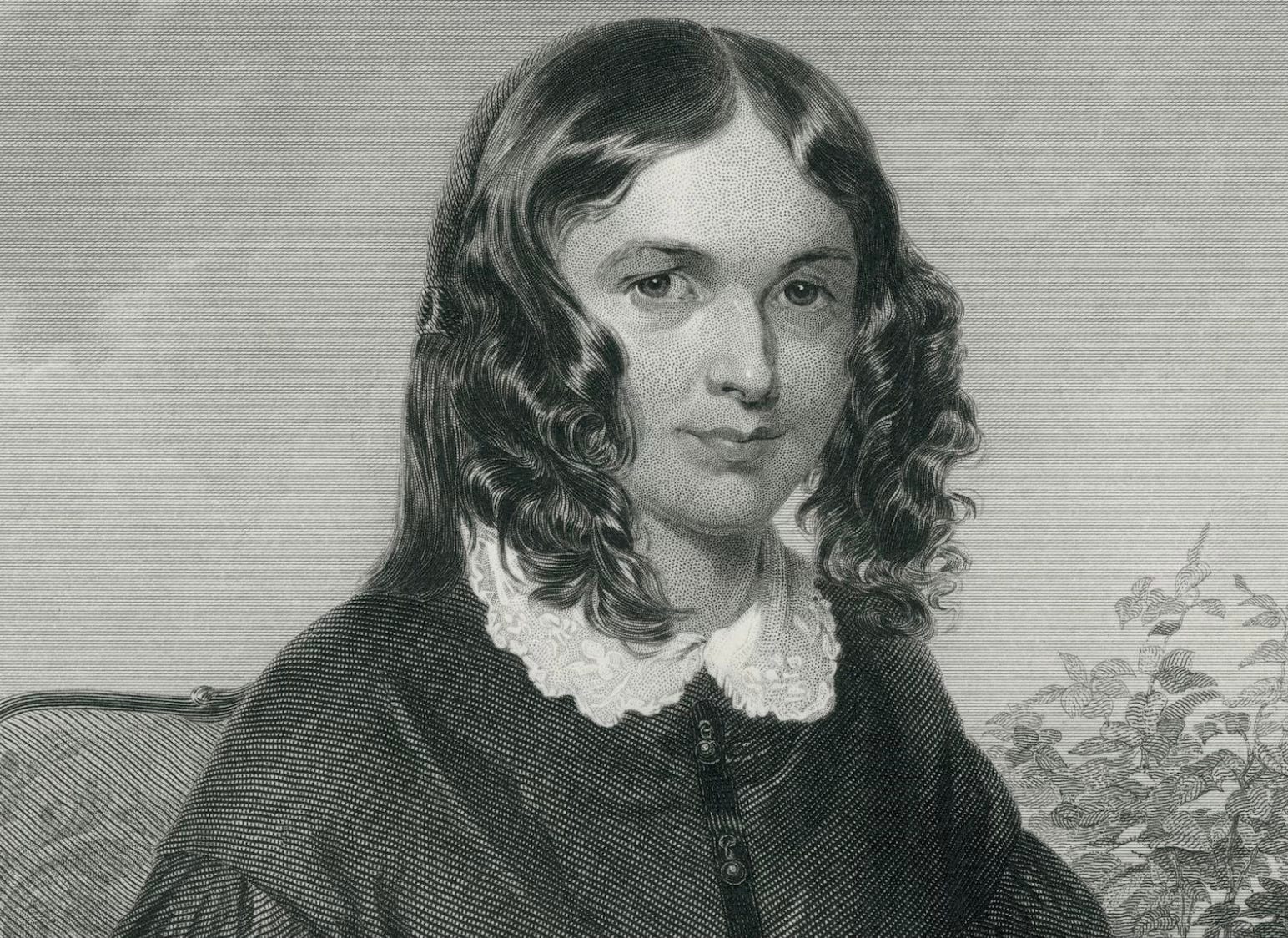
Elizabeth later wrote more poetry about love, and about religion, and she was a prominent anti-slavery voice, including her 1850 poem “A Curse For A Nation,” directed at the United States in response to its Fugitive Slave Act of that year.
She suffered from the medical afflictions of her youth throughout her life.
However, marriage to Browning lifted her spirit. Italy’s warmer climate was also a boon. He got her moving, so it seems she spent her life managing her pain instead of enduring it. She was able to give birth, even with the pain and at an advanced age for the time, 43, to a son named Pen.
Best I recollect, I found this slim volume in Bin 3 of my Goodwill Outlet. I had heard her name, but that’s all. I didn’t know her story. The bare-bones account of it in the introduction was so beautiful that I had to keep it for another of these, my Goodwill Book Reviews.
I was so taken by it that I began to look for more on her story.
Barrett Browning apparently came to view the opiate painkillers she used — laudanum and, later, more-powerful morphine — as essential to her creativity.
Researchers, however, believe evidence is clear that she was addicted to morphine, that the drug was a major contributor to her illness later in life, and indeed crippled her talent in her last years. One has suggested that she overdosed on morphine.
Sonnets from the Portuguese, written in the throes of unexpected romance, were her last major literary output.
In fact, they may have been followed by, in the words of a biographer, an “anti-climax which depressed her,” as if she was unsure what could equal it. The morphine addiction may have weakened her and kept her from focusing the way a writer must.
Funny what you find when you dig into a story more deeply.
Elizabeth Barrett Browning died in 1861, supposedly in her husband’s arms, at the age of 55, after 15 years of marriage to Robert Browning, who would live 28 more years and gain his own literary fame.
She left behind a life and verse that have enthralled romantics and storytellers ever since — including me.
Thank you for reading! I would never paywall this newsletter. …
But if you’d like to keep it going, please consider becoming a paid subscriber. It supports my journalism and ensures that every article will remain open to everyone:
Thank you for your support!
Hear Dame Judy Dench read `How Do I Love Thee?’
More Dreamland Newsletter stories worth your time:
The Greatest Tuba Player in the Rio Grande Valley
(from my next book, THE PERFECT TUBA: Forging Fulfillment from the Bass Horn, Band, and Hard Work — out Sept. 30)
Talking Crime Reporting, Walking the Tenderloin
(A video in which I review a mystery novel and talk about my first job as a crime reporter)
A Walk up the Street
(A story from a student in my nonfiction writing workshops, Tell Your True Tale, about all that went into one night’s walk up a street in his neighborhood. Great story.)
Scary how morphine opened up so many creative folks’ world and then became it.
A volume of EBB was given to me as a graduation present from my high school English teacher and is still one that I return to in times of struggle or for inspiration with line breaks and word choice. I adored this post because I got to experience a great writer’s discovery of her! Now, I will go back and read her again. Thank you, Sam!!!!!